Asteroid probe finds moon spinning wildly after NASA crash
The ESA spacecraft reveals a stadium-sized crater and hundreds of new rocks orbiting the target of the 2022 deflection test.
By Tomas Gonzalez ·
In September 2022, NASA crashed a small solar-powered probe into the asteroid Dimorphos to test a method for moving space rocks away from Earth. The mission succeeded by shortening Dimorphos’s orbit around its larger companion, Didymos, by 33 minutes. That change was 25 times greater than the most conservative models predicted. Now, a follow-up probe has returned to the site to document the long-term effects of that collision.
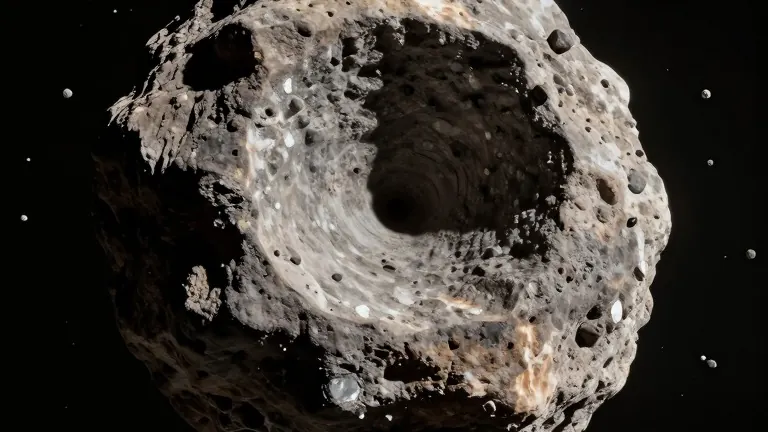
The European Space Agency’s Hera spacecraft arrived in the vicinity of the double asteroid system on Wednesday after a two-year journey from a launch pad in Florida. ESA released the first images from the mission on that date. The photos show a chaotic scene that scientists had not fully anticipated. The impact site is a crater roughly the size of a stadium, nearly as large as Dimorphos itself. The smaller asteroid measures about 500 feet across.
Patrick Michel, the Hera principal investigator from Côte d’Azur Observatory in France, explained that the result defied simple prediction. He told Ars Technica that researchers expected either a crater or a reshaping of the asteroid. Instead, they found both. “The crater is so large that the shape has changed,” Michel said. He described the current state as a transition between local cratering and global transformation, a process scientists do not yet fully understand.
The most striking change is in the motion of Dimorphos. Michael Kueppers, ESA’s Hera mission scientist, noted that the moon is no longer stable. “As Hera returned more images, it became clear that the DART impact has left Dimorphos tumbling wildly in its orbit,” he said. This wild spin contrasts with the larger Didymos, which continues to rotate on its axis just as NASA’s DART probe observed during its final approach four years ago.
Hera also discovered that the asteroids are not alone. The spacecraft spotted hundreds of boulders surrounding the pair. Naomi Murdoch, a planetary scientist at the Institut Supérieur de l’Aéronautique et de l’Espace in Toulouse, France, described the surprise. “We quickly realized the asteroids were not alone,” Murdoch said. “In fact, they had a lot of company.”
An image released by ESA combines 11 long-exposure frames from Hera’s hyperspectral camera. Ground processors digitally removed the brighter Didymos and Dimorphos to reveal the dimmer objects behind them. Murdoch stated that these fragments range in size from a football to a washing machine. The debris field was visible in a Hubble Space Telescope image taken shortly after the 2022 impact, but Hera’s view confirms the extent of the swarm.
Scientists have two main theories for the origin of these rocks. The simplest explanation is that they were ejected from Dimorphos when DART struck it. However, researchers caution that more data is needed to confirm this. The debris could also be ancient material left over from the formation of Dimorphos itself. Hera is the first mission to study an asteroid with its own moon in such detail.
Over the next six months, Hera will fly closer to both asteroids to gather more detailed observations. The spacecraft will release two small sub-satellites to attempt landings on Dimorphos. These probes will collect data on the asteroid’s composition, internal structure, and mass. This information will help scientists reconstruct the dynamics of the 2022 impact.
Understanding the physical properties of Dimorphos will anchor predictive computer models. These models will help determine how to deflect different types of near-Earth asteroids in the future. Sabina Raducan, a planetary scientist at the International Space Science Institute in Switzerland, noted that while the success of DART was clear, the details were missing. “We didn’t really know what kind of mess,” she said. Hera is now filling in those missing pieces.
The double asteroid system currently orbits the Sun about 120 million miles from Earth. Didymos and Dimorphos were chosen for the experiment because they resemble many near-Earth rocks but pose no threat of striking Earth. The data Hera collects will serve as a baseline for future planetary defense missions, providing a concrete reference for how kinetic impacts alter asteroid behavior.