Liberia's Thanksgiving: A 140-Year Tradition
Liberian families mark the first Thursday in November with church services, shared meals, and a national holiday rooted in 19th-century settler history and 1883 sovereignty gains.
By Julian Schulz ·
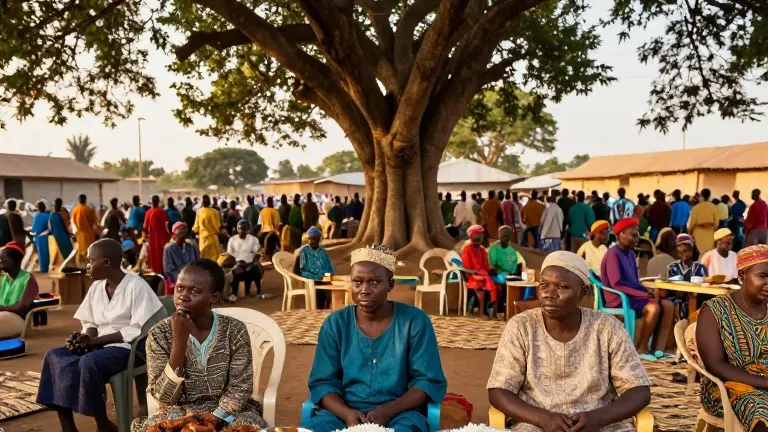
The first Thursday in November brings a specific rhythm to Liberian households, marked by large family gatherings and religious observances that differ sharply from American norms.
The holiday traces its origins to the first half of the 19th century, when the American Colonization Society established a community in West Africa. Black Americans, including both those born free and emancipated enslaved people, settled in the area that would become Liberia. Some departures were voluntary, while others were forced. Yvonne Capehart Weah, a program manager for the We-Care Foundation in Liberia, notes that these early settlers brought the Thanksgiving tradition with them.
The date and character of the holiday shifted in 1883. President Alfred Francis Russell, an Episcopalian priest, called upon God for protection against British territorial incursions. The legislature subsequently established Thanksgiving as a national holiday, framing it as a prayer of protection against intruders. Weah describes the invocation as a plea to prevent intrusion into Liberian territory.
Today, the day serves all faiths. Sekou Muhammad Sheriff, a YouTuber who documents Liberian culture, explains that Muslims attend mosques, while Christians and others observe the day as a holiday. For many, the celebration begins with morning church services. Weah summarizes the sentiment as giving thanks to God for freedom, divine protection, unity, and the harvest.
The mid-afternoon meal varies by household but rarely includes turkey. Weah’s family in Caldwell, the township where she grew up, gathers under a tree because the group is too large for a dining table. They eat fried, smoked, and roasted chicken, along with jollof rice, watermelon, pineapple, and various stews. A staple is fufu and soup, a mixture of cassava, fish, chicken, okra, and chili pepper. Weah insists the soup must be present at every Thanksgiving.
Sheriff recalls his childhood Thanksgiving meals, which included stews made with sweet potato leaves and snails, a dish he calls king's meat. He also remembers his father buying him a shirt-trouser suit and slippers for the occasion, with a white suit being his favorite. This year, Sheriff did not have the resources to host a gathering, but he remains grateful for his health and the peace in Liberia following civil conflicts that occurred between 1989 and 1997 and again from 1999 to 2003.
Weah, the eleventh of twelve siblings, views the holiday as a time to thank God for her past, present, and future. She works with an education nonprofit that teaches children literacy, operating on the belief that informed adults make better decisions affecting their social and economic lives.