Pope Leo XIV affirms spiritual bond with Israel in Buenos Aires
Addressing 100 religious leaders at the Argentine Foreign Ministry, the pontiff cited Vatican Council II teachings while Jewish officials noted the timing amid rising antisemitism in Europe.
By Tomas Gonzalez ·
Pope Leo XIV declared the Catholic Church's spiritual connection to the Jewish people during an interfaith ceremony in Buenos Aires on Monday.
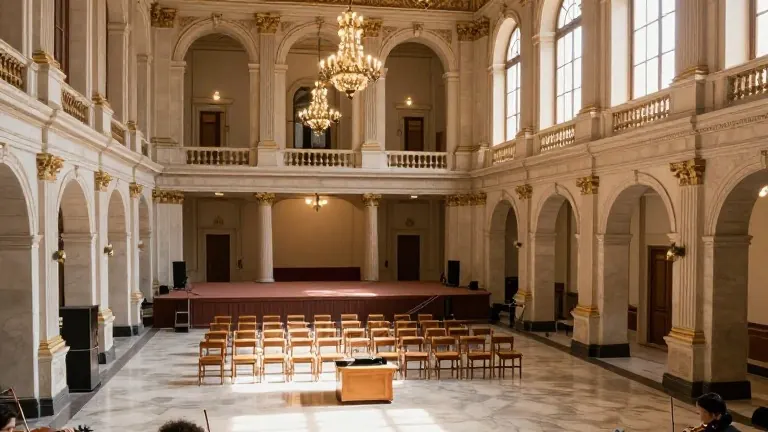
The pontiff spoke on Nov. 9 to roughly 100 religious representatives at San Martín Palace, the headquarters of Argentina's Foreign Ministry. He explicitly referenced the Second Vatican Council, which convened from 1962 to 1965, as the foundation for this stance. The council established the framework for the church's engagement with modern religious diversity.
Jewish leaders in Argentina described the remarks as timely. Isaac Sacca, the chief rabbi of the Sephardic Community in Buenos Aires, told the Jewish Telegraphic Agency that the statement was a pleasant surprise. He noted that antisemitism is resurfacing in Europe, making the pope's words meaningful to local communities. Sacca also serves as president of Menora, a Jewish youth organization. He said the gathering demonstrated how different faiths coexist in peace in Argentina.
Rabbi Marcelo Polakoff, the commissioner for interreligious dialogue for the World Jewish Congress in Latin America, emphasized the specific language used by the pope. Polakoff said the use of the term "People of Israel" was distinct from typical church documents. He viewed this choice as a sign of closeness that continues the legacy of interreligious dialogue established by John Paul II, Benedict XVI, and Francis. "Hearing those words from Pope Leo himself, just a few meters away, was very comforting," Polakoff said.
The pope also praised the historical role of immigration in shaping Argentine identity. He described the nation as a meeting point for various peoples and traditions. Leo stated that immigrants brought their dreams and faith to the country over the centuries. He noted that early arrivals included Catholics, Protestants, and Jews, who learned to work together and build communities. He described this process as an admirable blending of traditions with local customs.
Representatives from major Jewish organizations attended the meeting. These included delegates from AMIA, the primary Jewish community center in Buenos Aires, and DAIA, the political umbrella for the Argentine Jewish community. Eliahu Hamra, the chief rabbi of AMIA, said the pope stressed that religions act as guardians of human integrity. Hamra noted that this guardianship covers the spiritual, social, and communal dimensions of every person's dignity. The group expressed a united commitment to defending that dignity.
The event opened with a live orchestra playing a tango by Astor Piazzolla. Rabbi Sacca said this musical choice was distinctly Argentine and free of specific religious elements, showing respect for all faiths present. The gathering ended with a minute of silence for world peace and victims of violence. Rabbi Ariel Stofenmacher, rector of the Latin American Rabbinical Seminary, said the pope revisited the ideas behind Nostra Aetate, the 1965 document that recalibrated church relations with other religions. Stofenmacher also mentioned the World Jewish Congress document Kishreinu, a Jewish response to that 1965 text.
The interfaith meeting was the second event of the pope's visit to Buenos Aires. On Sunday, Nov. 8, he visited a residential care facility for people with disabilities on the city's outskirts. He then celebrated Mass at Palermo Park before an estimated crowd of more than 2 million. The four day visit began following a trip to Uruguay. On Tuesday, the pope traveled to Córdoba province for another Mass. He plans to visit Luján on Wednesday before departing for Lima, Peru, the final stop of his South American tour.