Renfe and Iryo Trains Crash in Toledo, Killing 69
A safety system failure and manual override led to a high-speed collision on the Madrid-Seville line, marking Spain's third fatal rail accident in 2026.
By Nia Foster ·
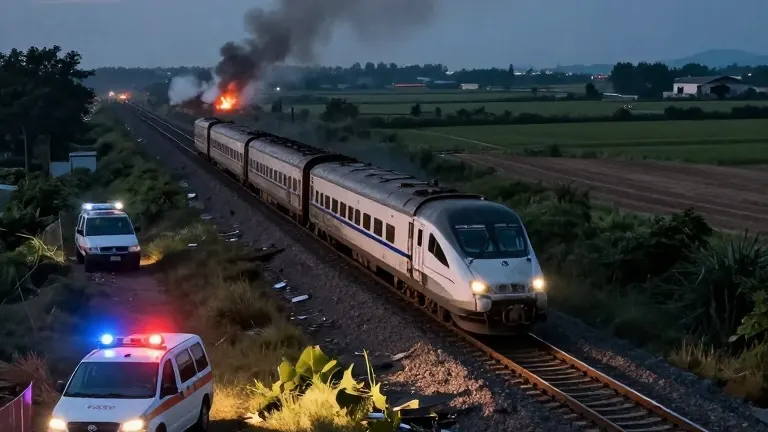
At least 69 people died and 110 were injured when two high-speed trains collided near Urda in Toledo province on Wednesday. The accident occurred on the rail line connecting Madrid and Seville, disrupting a major commercial corridor for Spain.
Transportation Minister Oscar Puente identified a failure in the LZB train management safety system as the initial trigger. This malfunction stopped all traffic on a 63-kilometer stretch of track. ADIF, the state-owned railway manager, assumed manual control and issued an order for a Renfe train to proceed southbound despite a red signal.
The Renfe train, carrying 393 passengers, resumed motion at approximately 124 miles per hour between 8:36 a.m. and 8:52 a.m. local time. It rear-ended a stationary Iryo train, which was operated by a private company and carried 151 passengers. The impact left several Renfe cars tilted on their sides and caused heavy damage to the Iryo carriages.
Puente described the decision to authorize movement against a red light as made under inexplicable circumstances. He stated that the train was authorized to proceed without speed restrictions due to an erroneous order from a controller. The minister announced a full investigation into the incident will follow.
Regional government data released Thursday morning indicated that 60 of the 110 injured passengers have been released from hospitals. Among the dead, 24 were aboard the Renfe service and 44 were on the Iryo service. The U.S. State Department confirmed that several American citizens were injured in the collision.
Passengers described chaotic conditions during the crash. Patricia, a survivor on the Renfe train, said the vehicle had been stopped for about 20 minutes before the accident. She reported that people were thrown into the air and that structural parts of other cars entered her carriage. Another passenger, a 25-year-old man named Yoander, said he was sleeping when he was thrown forward into the seats ahead of him.
The trade union CSIF called for the resignation of the transport minister following his comments. The union asked the government to respect the presumption of innocence for the ADIF head of traffic while maintaining that the decision to proceed was flawed. The train drivers' union Semaf will hold a pre-planned nationwide strike on Thursday to demand stronger safety measures.
This is the third deadly rail incident in Spain this year. A previous crash in January in Cordoba province killed more than 40 people when a train derailed due to a track break. A separate accident near Barcelona in early 2026 killed a train driver during heavy rainfall. The current crash site is approximately 130 miles from the January disaster location.
Emergency operations deployed more than 500 personnel, three helicopters, and several drones to the scene. The Spanish Civil Guard opened four offices in different cities to identify victims. The regional government of Castilla and La Mancha requested blood donations at sites in Alcazar de San Juan, Ciudad Real, and Toledo. Service on the Madrid-Seville line remains suspended.
Prime Minister Pedro Sanchez visited the scene and declared that Spain is in mourning. He stated that any negligence will be exposed and that failures in the safety system will be addressed with firmness. Sanchez acknowledged that the country has suffered two terrible tragedies involving high-speed rail in the same year.
Source: ABC7 New York
More Business · Consumer Watch · Report a business · Got a Story?