Serbia's Student List Pledges to End Arms Trade With Israel in Break From Vucic Era
Serbia's newly empowered Student List has vowed to stop weapons sales to Israel and scrap an Israeli-linked drone project, marking a sharp turn away from the military ties built under former President Aleksandar Vucic.
By Tomas Gonzalez ·
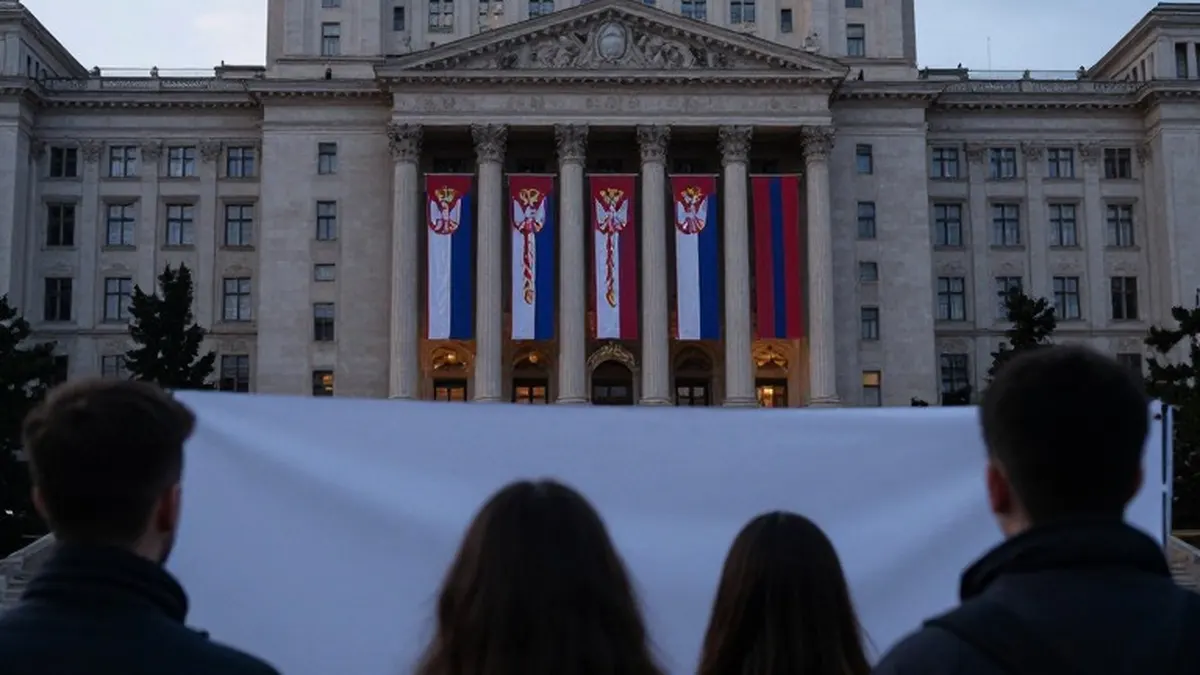
Serbia's Student List, fresh off a decisive election victory, has promised to end the country's arms trade with Israel and shut down an Israeli-linked drone assembly project on Serbian soil, pointing to a potential rupture with the close defence relationship cultivated by former President Aleksandar Vucic.
The pledge was delivered last week by Filip Ubovic, a representative of the movement, during an appearance on a podcast hosted by British journalist Aaron Bastani. Asked about Israel's war on Gaza, Ubovic said: 'What is happening there is a stain on humanity's conscience, and it is truly regrettable. Our platform clearly states that we will end the arms trade with Israel.'
The Student List captured 140 of 250 seats in the snap election held on 25 October, winning an outright majority and defeating Vucic's bloc following years of allegations that his government had grown increasingly authoritarian and corrupt. Just a month before the vote, in September, Vucic had inaugurated a factory in Serbia that assembles Israeli-made drones.
Military commerce between the two countries has expanded sharply in recent years. According to a joint investigation by the Balkan Investigative Reporting Network and Haaretz, Serbian arms exports to Israel climbed from $1.5m to $45.8m in 2024, a surge that coincided with Israel's genocide in Gaza.
Belgrade also deepened its purchases of Israeli weaponry. In early 2025 Serbia acquired Elbit Systems' PULS artillery systems and Hermes drones for $335m, and in August of that year it spent roughly $1.6bn on long-range missiles, drones and electronic warfare equipment. Elbit, the Israeli arms manufacturer, has been pushing to expand its footprint in the Balkans, pursuing factory projects in both Serbia and Albania.
Vuk Vuksanovic, a lecturer in foreign policy and grand strategy at the Department of War Studies at King's College London, told Middle East Eye that the future of Elbit's investments in Serbia and of bilateral ties 'remains uncertain'. He noted that Serbian society has long been split on the Israeli-Palestinian question, with some Serbs feeling emotional bonds with the global Jewish community rooted in shared victimhood during World War II, while many others express solidarity with Palestinians as a legacy of non-aligned Yugoslavia.
Vuksanovic said solidarity with Palestinians has grown in recent years, particularly with the rise of the Student Movement, which he linked to greater global awareness of Palestinian suffering. 'Many believe that the extent of the Gaza tragedy exceeds the past history of friendship with Israel and Israelis,' he said, adding that many Serbs saw Vucic's closeness with Israel, including ammunition deliveries, not as national interest policy but as a self-interested effort by the old clique to curry favour with Israel, its lobby groups and, by extension, the Trump administration.
Vucic struck back after the announcement, accusing the Student List of undermining Serbia's defences. In a 12 November Instagram video, the former president framed the pledge as a refusal to cooperate with Israel and even claimed the movement would decline to work with China, though Ubovic's commitment concerned only the arms trade with Israel and the drone project in Serbia. Vucic declared that 'the disintegration of the defence and security sector of Serbia has begun, and everything is on the order of foreign intelligence agencies'.
Vuksanovic cautioned that honouring the pledge will be difficult, saying 'while the desire and intention are noble and sincere, in practice this will be tougher to implement', citing lost military industry income, technological and supply chain links created by the Elbit factory, and the legal force of existing contracts. 'The issue is how to implement this break gradually without fully destroying the partnership with Israel, and without making Israel an enemy, and potentially its interest groups in the US,' he said. 'Paradoxically, this relationship may prove harder to transform than Serbia's relations with the EU, the US, Russia, and China.'
Middle East Eye said it contacted the Student List for comment but had received no response by the time of publication.