Swinging motions in virtual reality speed up learning
A joint study shows that large physical gestures help people categorize visual information four to six times faster than pressing buttons.
By Julian Schulz ·
Researchers at Florida Atlantic University and Brown University found that incorporating large physical movements into virtual reality tasks dramatically accelerates the learning process for complex categorization. The study focused on how bodily motion influences the brain's ability to process and retain information about visual patterns.
The investigation began with a controlled experiment designed to test the hypothesis that movement aids cognitive tasks. Luke Rosedahl, an assistant professor of Biomedical Engineering at Florida Atlantic University, led the effort using VR gaming technology to observe how different types of input affected performance.
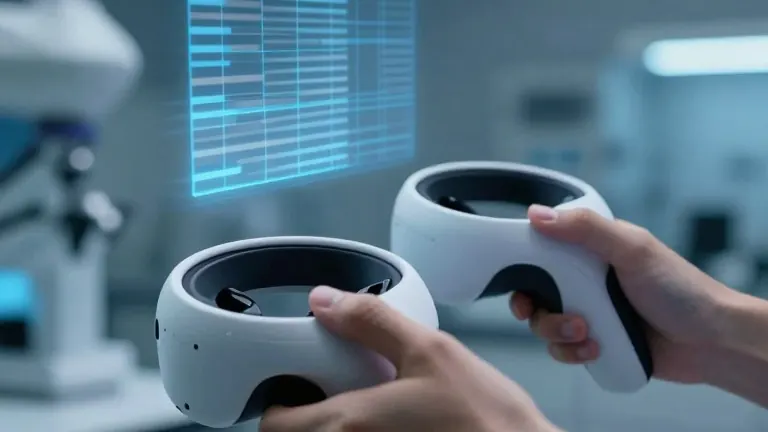
In the laboratory, participants wore VR goggles and viewed a series of striped objects on a screen. Their task was to sort these stripes into specific categories as the virtual game progressed. The researchers divided the group into two distinct testing conditions to compare methods.
One group learned by pressing buttons, a low-effort action. The other group performed much larger physical motions, such as swinging a virtual lightsaber to hit the stripes or punching a response box located in front of them. The physical exertion in the second group was visibly distinct from the button pressing of the first.
The results showed a clear advantage for the group using large movements. Rosedahl told NPR's Emily Kwong that people using actions like punching learned between four and six times faster than those using smaller motions. He described this speed increase as absolutely incredible based on the data collected during the session.
The study provides concrete evidence that the scale of movement matters in virtual training environments. By linking specific physical actions to cognitive tasks, the researchers demonstrated a measurable difference in how quickly participants mastered the categorization rules. The findings suggest that designing VR interfaces with large, active gestures could make learning more efficient for certain types of complex data.
Source: Brown University News