Victorian election leaders clash in sole debate as polls remain tight
A lively political forum in Melbourne featured sharp exchanges between the major party leaders, with Greens leader Ellen Sandell emerging as a standout performer in the eyes of undecided voters.
By Tomas Gonzalez ·
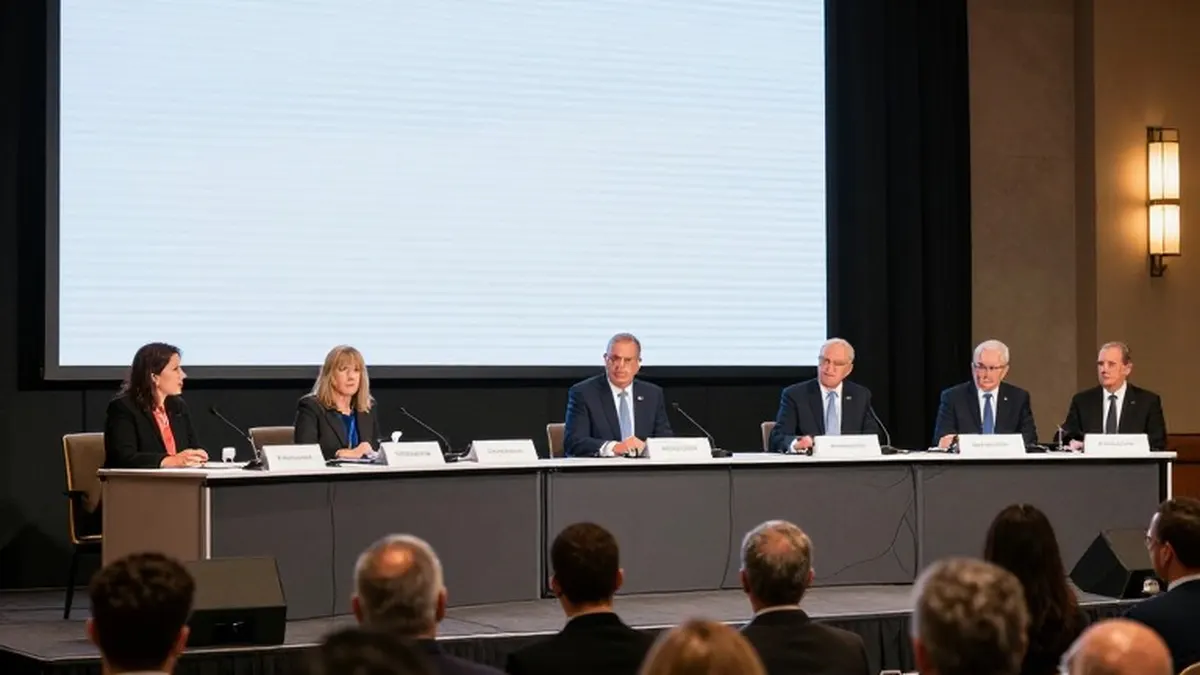
The Victorian state election campaign received a significant boost in energy on Tuesday night as the major political leaders faced off in the only formal debate scheduled for the contest. Two weeks into the official campaign period, the race had previously been described as lacking excitement, with the governing Labor party experiencing a decline in polling support while the Coalition opposition focused on a steady path to victory. The event, branded as the People’s Forum by hosts News24 and the Herald Sun, provided a platform for political theater and direct confrontation.
Opposition leader Jess Wilson engaged in a notable exchange with Premier Ben Carroll regarding the naming of his predecessors. Wilson mocked Carroll for avoiding the names of Daniel Andrews and Jacinta Allan, suggesting they were not to be spoken of as if they were ghosts. Carroll defended his stance by noting that he could mention the name of former premier Jeff Kennett, a point Wilson immediately seized upon. Despite the back and forth, Carroll did not explicitly say the names of his two recent predecessors during the segment.
The debate also featured a moment characterized by the media as a strong defense of her policy costings. Wilson pushed back against claims that her government’s plans would require cuts to healthcare to manage debt, arguing that the Labor government had accumulated significant state debt. She asserted that she would not be lectured on financial matters by a government that had racked up substantial liabilities, a stance that resonated with some in the audience.
One Nation Victorian leader Warren Pickering contributed a vivid analogy, comparing the state’s crime situation to Gotham City. He expressed a firm intention to increase incarceration rates, even if it meant transferring prisoners to other states. Pickering stated that he was unbothered by the prospect of full prisons and highlighted the availability of new facilities in New South Wales as a destination for offenders who had broken the law.
Greens leader Ellen Sandell, whose inclusion on the panel followed a dispute between Carroll and Wilson, was widely praised for her performance. Addressing an audience of undecided voters, Sandell highlighted the changing nature of politics by noting the presence of four leaders on stage. She took all three other parties to task on their funding sources, linking industry donations from gambling, property, and mining sectors to the cost of living challenges faced by residents. Sandell specifically criticized the influence of billionaire Gina Rinehart on One Nation policy.
Sandell and Wilson engaged in a detailed exchange on several issues, including the potential for a confidence and supply arrangement in a hung parliament. Sandell argued that the Greens’ values were significantly different from the Coalition’s, citing differences in views on treaty and renewable energy. The two leaders also clashed over pro-Palestinian protests in Melbourne’s central business district, with Sandell defending the right to peaceful protest and Wilson arguing that some incidents had lost their peaceful character. Sandell argued that politicians should not decide who gets to protest, a view Pickering also supported.
Wilson, who currently holds a lead in the polls, largely avoided taking bait from her opponents. She maintained that the Coalition is guided by practicality rather than ideology. When asked about the Suburban Rail Loop, she left open the possibility of reviewing the multibillion dollar project once the coalition has full visibility of existing contracts. Premier Carroll, in his turn, acknowledged past mistakes by his government but leaned heavily on its record, including the construction of new schools, high teacher wages, and the recruitment of thousands of nurses.
The debate was moderated by Kieran Gilbert, and it was confirmed that no further leaders’ debate would take place on free-to-air television due to disagreements over terms between Carroll and Wilson. As the audience left the venue, they were polled to determine the perceived winner of the night.
The results of the exit poll indicated that 39% of attendees believed Wilson had won the debate. Sandell followed with 25%, while Pickering received 16%. Only 13% of the audience remained undecided, and just 7% selected Carroll as the winner. The outcome suggests that the premier’s message is struggling to resonate with a segment of the electorate that may have already stopped listening to the Labor government.