Hera reveals chaotic aftermath of DART asteroid collision
The European Space Agency's Hera spacecraft has captured images showing that the DART impact left Dimorphos tumbling and surrounded by hundreds of boulders.
By Nia Foster ·
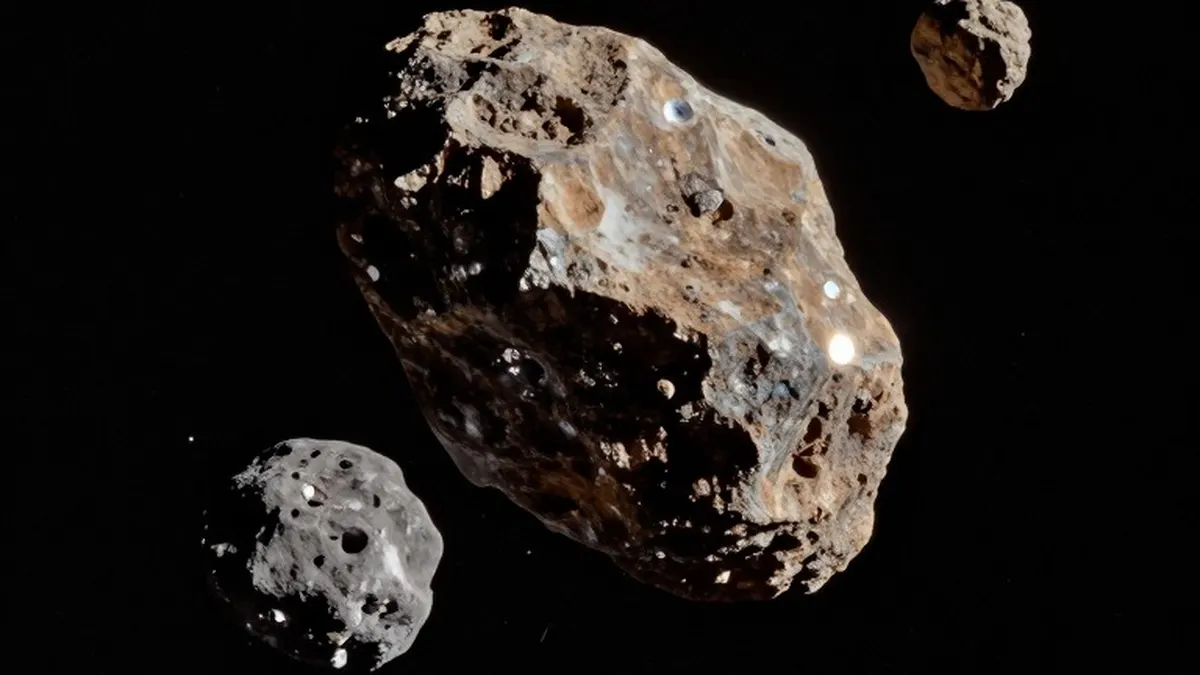
NASA's Double Asteroid Redirection Test concluded four years ago with a successful collision that permanently altered the orbit of the asteroid Dimorphos. The spacecraft struck its target in September 2022, releasing significant energy to shorten the asteroid's orbit around its larger companion, Didymos. While ground-based telescopes confirmed the change in trajectory, the destruction of the DART probe left many questions about the physical state of the surface unanswerable.
To fill in these gaps, the European Space Agency launched the Hera spacecraft on a two-year journey from Florida. Hera recently arrived in the vicinity of the binary asteroid system, which is currently orbiting the Sun approximately 193.5 million kilometers from Earth. Mission planners selected this pair because it resembles many near-Earth asteroids while posing no threat to the planet.
On Wednesday, the ESA released the first views from Hera, revealing a chaotic scene. The images show that the car-sized impactor carved out a crater nearly as large as Dimorphos itself. The asteroid measures roughly 151 meters across, and the new crater is described as being the size of a stadium. Patrick Michel, the principal investigator for Hera, noted that the impact did both what was predicted and what was unexpected. It created a crater so large that it reshaped the asteroid's overall form, placing it in a transitional state between simple cratering and global transformation.
Beyond the surface damage, Hera has observed that Dimorphos is no longer stable. Michael Kueppers, the ESA mission scientist, stated that the impact has left the smaller asteroid tumbling wildly in its orbit. This contrasts with the larger Didymos, which continues to spin on its axis as it did when DART approached in 2022. The tumbling motion provides critical data for understanding how momentum is transferred in such collisions.
In its initial reconnaissance, Hera also discovered hundreds of boulders surrounding the double asteroid. This finding surprised scientists, who had only seen a cloud of material in Hubble Space Telescope images taken shortly after the 2022 impact. Naomi Murdoch, a planetary scientist involved in the mission, explained that the asteroids were not alone and had significant company. The debris field consists of rock fragments ranging in size from a football to a washing machine.
An image released by the ESA combines multiple long-exposure frames from Hera's hyperspectral camera. By digitally removing the brighter asteroids, engineers revealed the dimmer streaks and dots of the debris swarm. While one explanation is that these boulders were ejected during the DART impact, scientists are cautious. The debris could also be ancient relics from the formation of Dimorphos. Hera is the first mission to conduct a sustained study of an asteroid with a moon, making this distinction important for planetary defense models.
Over the next six months, Hera will fly closer to the asteroids to gather detailed observations. The spacecraft will also release two small sub-satellites to attempt landings on Dimorphos. These probes will collect data on the asteroid's composition, internal structure, and mass. This information will help scientists reconstruct the dynamics of the DART impact and improve predictive models for future deflection missions.
Sabina Raducan, a planetary scientist at the International Space Science Institute, noted that while the success of the DART impact was clear, the specific nature of the disruption remained unknown. With Hera's arrival, the missing pieces of the puzzle are beginning to emerge. As Michel stated, understanding these dynamics represents a breakthrough that effectively solves the challenge of planetary defense.
More News · National news · Report a business · Got a Story?