Bangladesh Police Use Tear Gas as 20,000 Garment Workers Block Dhaka Highway
Unrest in the $40 billion industry has led to widespread factory closures and clashes as workers demand a 30,000 taka monthly wage.
By Nia Foster ·
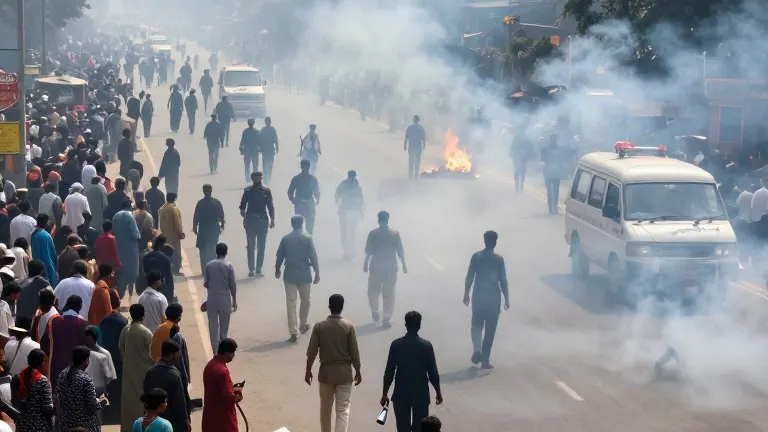
Police in Bangladesh deployed tear gas and stun grenades on Wednesday to disperse thousands of garment workers who blocked the Dhaka-Aricha Highway in Savar. The confrontation involved approximately 20,000 demonstrators in the area outside the capital. Officers charged the crowd with batons to clear the route. It was not immediately clear how many people were injured in the clash.
The unrest expanded to the nearby Ashulia area and the Gazipur district, which is a major industrial zone near Dhaka. Local police chief Saiful Alam stated that officers acted to clear the highway after protesters threw stones at them. In Gazipur, demonstrators blocked the Dhaka-Mymensingh highway and set fire to a police vehicle. Police responded by firing tear gas and stun grenades during the disturbances.
About 25 factories in Ashulia shut down due to the chaos, according to police. Many other plants have remained closed under a no work, no pay provision in labor laws. This rule allows owners to suspend operations during periods of unrest. Disruptions to production have become routine in recent weeks as hundreds of factories have closed.
Workers are demanding a minimum monthly wage of 30,000 takas, which is equivalent to $236. This is a major increase from the current rate of 12,500 takas, or $98. Protesters say that rising living costs and inflation have reduced their purchasing power. They are asking for the new rate to cover basic needs.
The garment sector is a primary source of income for the country, generating about $40 billion in annual exports. There are approximately 2,500 factories in the industry. Roughly 4 million workers are directly employed in these plants. Most of them are women from rural areas of Bangladesh. The broader supply chain supports several million additional jobs.
The government has created a board to determine a new wage package, but the effort has not satisfied the protesters. The Bangladesh Garment Manufacturers and Exporters Association and the Bangladesh Knitwear Manufacturers and Exporters Association have asked for protection of their factories amid the ongoing strikes.
The protests intensified earlier in November. The conflict has drawn attention to the working conditions in one of the world's largest apparel industries. The demand for higher wages continues to drive daily disruptions in the country's main export sector.