European shares drop as AI concerns and US tech slump spread globally
Global stock markets fell sharply on Friday after a severe sell-off in US technology stocks, driven by fears of an AI industry slowdown following the Democratic midterm victory.
By Tomas Gonzalez ·
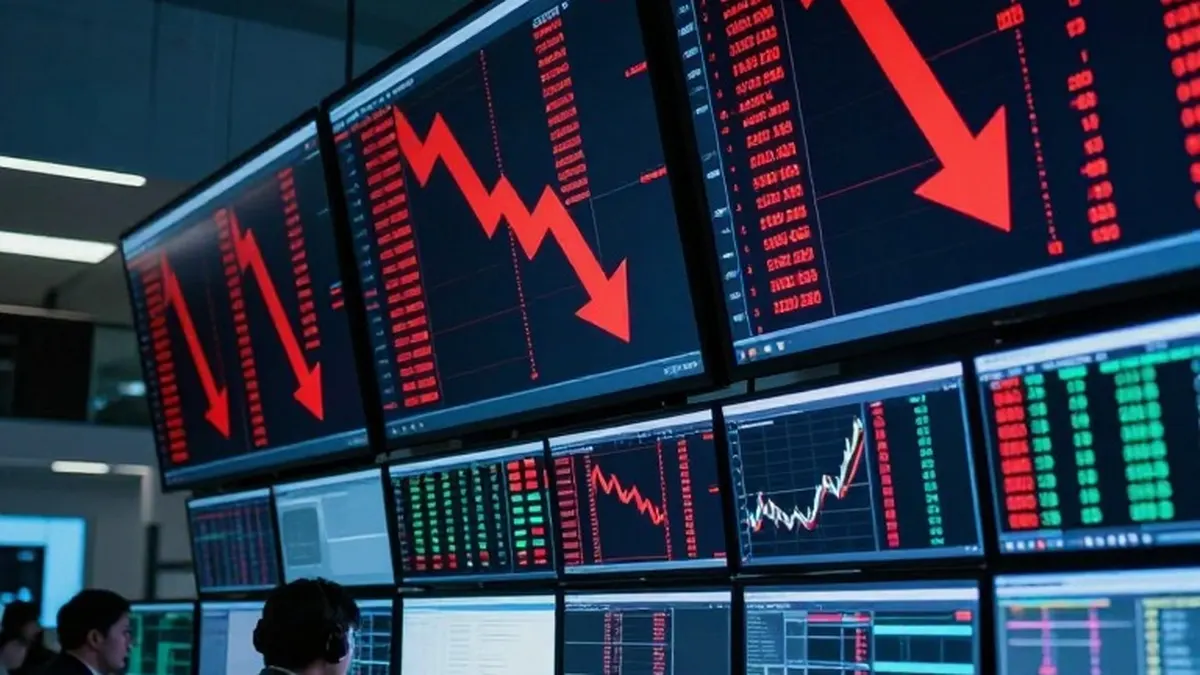
European stock markets experienced a significant decline on Friday as the impact of a US technology sell-off extended across the Atlantic. The downturn was triggered by investor anxiety over a potential slowdown in the artificial intelligence sector, a sentiment that intensified after the Democrats secured a victory in the recent midterm elections. This shift in political landscape has led analysts to question the future trajectory of AI-related spending.
The financial turmoil began on Wall Street on Thursday, where the Nasdaq share index recorded its steepest drop in 19 months, plunging by 5.5%. This sharp decline was quickly mirrored in Asian markets on Friday morning, with Japan's Nikkei 225 index sinking by 6% and South Korea's Kospi index falling more than 8% during early trading hours. The negative sentiment subsequently reached London, dragging down European benchmarks.
In the United Kingdom, the FTSE 100 index, which tracks major blue-chip companies listed in London, opened 1.5% lower, or 166 points down, at 10,615. AstraZeneca was the worst performer on the index, with its shares opening down 2.8%. Other notable declines included IAG, the parent company of British Airways and Iberia, which fell 1.5% after reporting that it had missed profit forecasts in a recent trading update. Mining companies Antofagasta and Anglo American also saw their shares drop.
The decline was not limited to the UK. Germany's Dax index opened 1.5% lower, while France's Cac 40 dropped by 1.2%. Spain's Ibex index also fell, losing 1.1% of its value. These moves reflect a broad-based retreat from riskier assets as investors reassess their portfolios in light of the changing technological and political environment.
Susannah Streeter, the chief investment strategist at Wealth Club, noted that the tech sell-off has intensified, with the pain from Wall Street carried straight through to Asia and knocking sentiment in Europe. She highlighted that major concerns are colliding, specifically the potential slowdown in datacenter construction, which threatens to disrupt the spending spree that has underpinned the current boom. This occurs at a critical time when investors are already nervous about the returns on these massive investments.
Chip manufacturers led the recent slump in the US market. SanDisk, a memory maker, saw its shares tumble by 22%, while Western Digital, a hard drive manufacturer, fell by 17%. The volatility was further underscored by a 61% jump in the Vix, often referred to as Wall Street's fear index. This spike pushed volatility levels to their highest point since the early weeks of the Iran war, signaling heightened market uncertainty.
Despite the sharp losses observed in global stock markets this week, most major indices remain in positive territory for the year. The Nasdaq Composite index, for instance, is still up 4.6% since the start of January, although it is currently more than 10% below its recent peak. This suggests that while recent momentum has reversed, the broader upward trend of the year has not yet been completely erased.
Similarly, the FTSE 100 has gained almost 6.9% in 2026 to date. However, the index is now more than 300 points below the record high it set in July. Investors are left weighing the immediate impact of the AI slowdown fears against the longer-term performance of their holdings, with many watching to see if the current sell-off marks a temporary correction or the beginning of a more sustained downturn.
The interplay between political outcomes and technological trends continues to shape market dynamics. The Democratic midterm victory has introduced new variables into the investment equation, particularly regarding how AI infrastructure and regulation may evolve. As a result, traders are adopting a cautious approach, leading to the widespread declines seen across Europe and Asia on Friday.
Market participants are closely monitoring further developments in the coming days to determine if the current volatility will persist. The combination of high expectations for AI returns and the reality of slowing construction projects creates a challenging environment for investors. For now, the focus remains on how companies in the tech sector will respond to these shifting conditions and whether they can restore investor confidence.