Officials demand $50B for air traffic
Transportation and Homeland Security chiefs urge Congress to fund a full system replacement after Friday's four-hour nationwide ground stop.
By Tomas Gonzalez ·
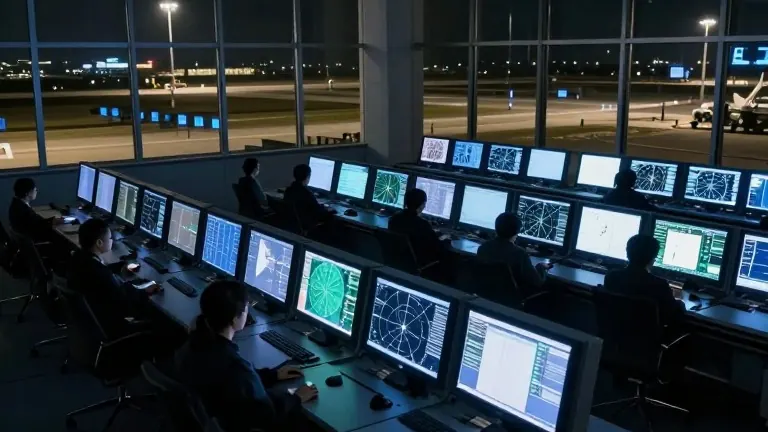
Federal officials called for $50 billion to replace the nation's aging air traffic control infrastructure following a four-hour nationwide ground stop that ended Friday night.
The FAA halted all U.S. flights at 4:00 p.m. EST on Friday. The agency lifted the order at 8:15 p.m. EST, reopening airspace for a slow return to normal operations. This marked the first widespread ground stop since a 90-minute halt in 2023 caused by a contractor outage. Before that, the last total freeze on American air travel occurred on Sept. 11, 2001.
During a post-incident briefing, Transportation Secretary Sean Duffy blamed an overload of data on network routers for the disruption. He stated that the routers provided inconsistent data, forcing the agency to shut the system down to prevent further issues. Homeland Security Secretary Markwayne Mullin said the public was never in danger during the stoppage. Mullin noted that officials have zero evidence a cyberattack caused the telecommunications failure, though federal investigators continue to probe the incident.
Duffy described the current system as incredibly old and argued against temporary fixes. He said the administration wants new hardware, new software, and new telecommunications. He noted that President Trump previously requested $30 billion for these updates. In later September, Duffy asked Congress for $30 billion to fund new technology, control towers, and airport improvements. That request coincided with the FAA's rollout of its Strategic Management of Airspace, Routes, and Trajectories, or SMART, an AI tool designed to help controllers anticipate congestion.
Mullin echoed the push for a complete overhaul. He estimated the cost at approximately $50 billion. Duffy urged every member of Congress to approve the funding. He said Americans would tell their representatives to give the administration the money to finish the job so late-night press conferences become a thing of the past.
The FAA plans to continue monitoring the system as flights resume. Officials expect the return to full capacity to take time.