US aircraft disables cargo ship in Gulf of Oman after blockade breach attempt
US Central Command reports that a Palau-flagged bulk carrier was struck and disabled after attempting to pass through the naval blockade of Iran.
By Julian Schulz ·
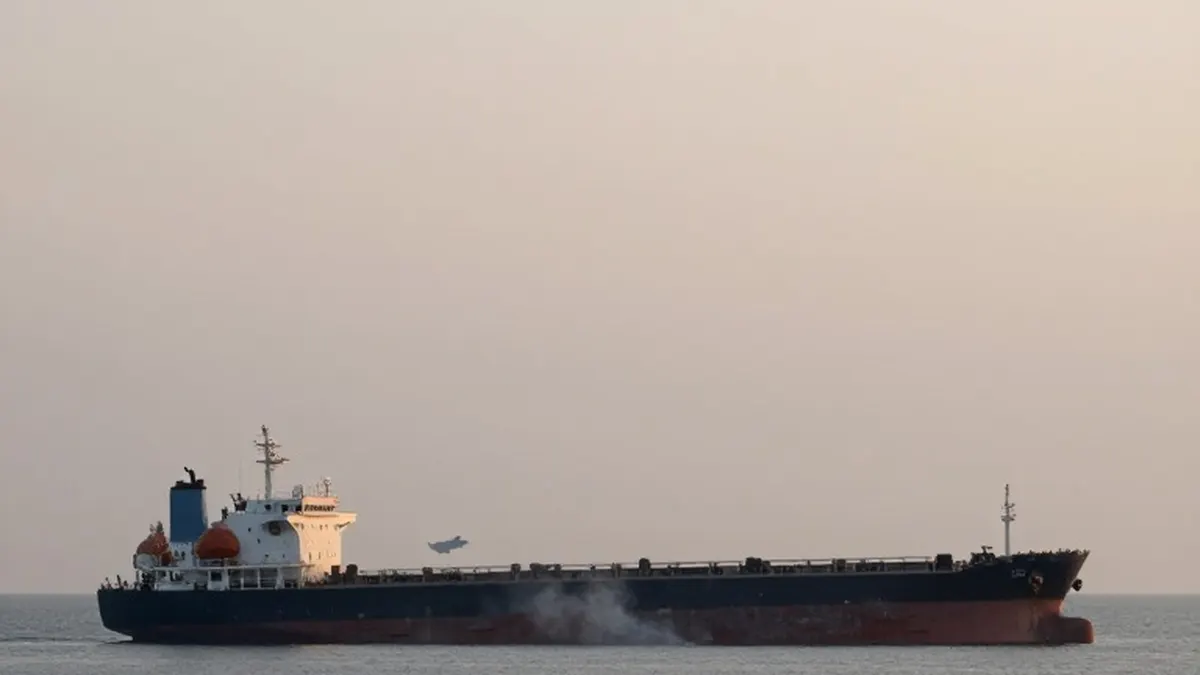
US military forces struck a commercial cargo vessel in the Gulf of Oman on Thursday, disabling it after the crew attempted to break through the naval blockade imposed on Iran. US Central Command, known as CENTCOM, confirmed the operation on Friday, stating that an aircraft targeted the ship after it failed to heed warnings.
The vessel identified by the command is the Pacific Archer, a bulk carrier flying the flag of Palau. Records indicate the ship had departed from the Iranian port of Bandar Abbas. CENTCOM officials explained that the crew received multiple alerts before the aircraft struck the stern of the ship. The impact disabled the vessel's propulsion system, bringing it to a halt in the water.
According to the military statement, all civilian crew members on board were unharmed. CENTCOM released a short video clip documenting the operation for public review. However, the command did not specify what cargo the ship was carrying or its intended final destination. It also did not clarify whether the disabled vessel had been towed away from the area following the strike.
Maritime registry data from ClassNK lists the Pacific Archer as a bulk carrier rather than an oil tanker. This distinction is relevant given the broader context of the blockade, which has significant implications for regional energy and trade flows.
The incident occurred just over a week after the US military expanded the scope of its blockade enforcement protocols. A maritime advisory issued on November 18 clarified that vessels could be treated as attempting to evade the blockade if they accepted cargo at sea that had originally been loaded in Iran. This rule applied even if the receiving vessel had not directly called at an Iranian port. CENTCOM did not allege that the Pacific Archer was involved in such a transfer at sea.
This is not the first time a merchant vessel has been disabled in this region recently. On November 7, US forces struck another ship named the Huda in the Gulf of Oman. CENTCOM reported that the crew of the Huda had ignored repeated warnings before the military took action.
The current phase of blockade enforcement began on July 14, according to data from the Joint Maritime Information Center. In an assessment published on Thursday, the center noted that commercial traffic passing through the Strait of Hormuz remains below the levels observed in 2025.
President Donald Trump addressed US service members on Thanksgiving, offering his defense of the naval strategy. He described the blockade as what he considered to be the most successful naval blockade in history.
The strikes highlight the increasing intensity of US enforcement actions in the Gulf of Oman. The military's willingness to expand the definition of blockade evasion and physically disable vessels that ignore warnings suggests a firm commitment to maintaining the maritime cordon around Iran.
Observers will continue to monitor the situation in the Strait of Hormuz, a critical chokepoint for global energy supplies. The recent events underscore the risks commercial shipping faces in the region while the blockade remains in effect.