Houthi Missiles Strike Aramco Tower: Riyadh's Economic Hub Takes Direct Hit
Windows shattered across multiple floors of the King Abdullah Financial District as the Iran-aligned group claims a four-front attack on the Saudi capital.
By Julian Schulz ·
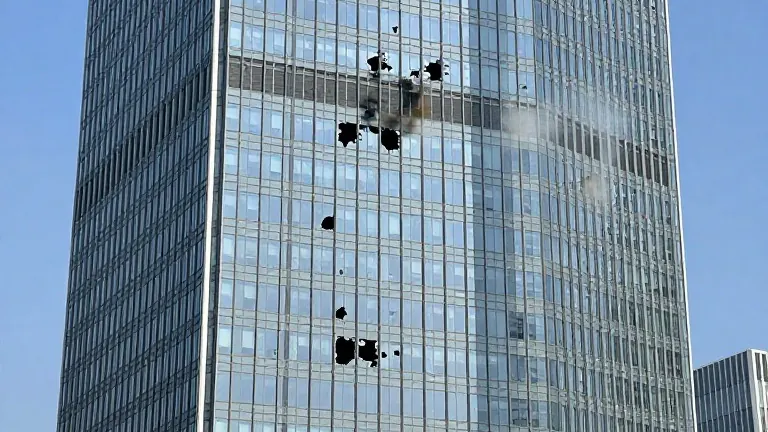
The King Abdullah Financial District in Riyadh sustained direct damage on Sunday when a projectile struck a skyscraper housing Saudi Aramco. Eyewitnesses reported windows blowing out across several floors of the building, marking a new phase in the Houthi campaign against the Saudi capital. The Saudi energy ministry confirmed that an administrative Aramco building was subjected to an attempted attack, noting that falling shrapnel caused minor damage. Officials reported no injuries or fatalities from the incident.
The strike occurred during a period of intense escalation in the Yemeni conflict. A truce signed in 2022 had temporarily paused fighting, but it collapsed in July when the Saudi-backed government bombed the airport in Sanaa. In response, the Houthis declared a maritime blockade and began targeting Saudi ships and oil infrastructure. The group has since seized control of the entire Red Sea coast. On Sunday, the Houthi military announced that they executed four operations using ballistic and cruise missiles and drones. Their targets included the financial district, Riyadh airport, Aramco storage tanks, and the eastern city of Abqaiq.
The specific targeting of the financial district carries high symbolic weight. The King Abdullah Financial District serves as a central hub for Saudi Arabia's economic reforms, housing the headquarters of the Public Investment Fund and the Saudi stock exchange. Major international firms, including Goldman Sachs, maintain offices in the area. The district also features residential buildings and a busy metro station, placing it in the heart of daily commuter traffic. Andreas Krieg, a researcher at the London-based consultancy MENA analytica, described the move as an attack on the credibility of Vision 2030. He stated that the strikes raise the political costs of the Yemen campaign and undermine the argument that airpower alone can restore deterrence.
The attack came just hours after the Saudi education ministry announced the return of in-person schooling in Riyadh. Students had been learning remotely for weeks following earlier waves of strikes. Coalition spokesperson Turki al-Malki said on Sunday that air defenses intercepted and destroyed two ballistic missiles launched toward the capital. Loud explosions were heard throughout the city. The interior ministry had recently warned residents not to film drones or impact sites, a directive that complicates independent verification of damage.
The conflict continues to expand in geographic scope and military involvement. The kingdom has sought assistance from allies to protect its cities from daily Houthi fire. Britain announced in October that it would fly fighter jets on defensive missions to support Saudi air defenses. On the ground, thousands of Syrian troops are set to deploy to Saudi Arabia and Yemen. Multiple Yemeni officials told AFP that some Syrian soldiers are already on the ground, although Syria's SANA news agency cited a diplomatic source saying Damascus had not sent troops to Yemen at that time.
The UN reports that more than 1,600 people have been killed and over 300,000 displaced since fighting resumed in Yemen. The conflict began in 2014 when the Houthis, an Iran-backed group, took control of the capital Sanaa. A Saudi-led coalition entered the war the following year to support the internationally recognized government. The group has repeatedly targeted Aramco facilities in recent months, including tankers, refineries, and storage areas. The Sunday strike on the financial tower adds a new layer to this ongoing pattern of attacks on the kingdom's economic infrastructure.