Why Massachusetts Still Allows Highway Billboards
Four U.S. states have banned off-premises billboards, but Massachusetts has not, leaving drivers to navigate a multibillion-dollar industry that dominates the roads.
By Nia Foster ·
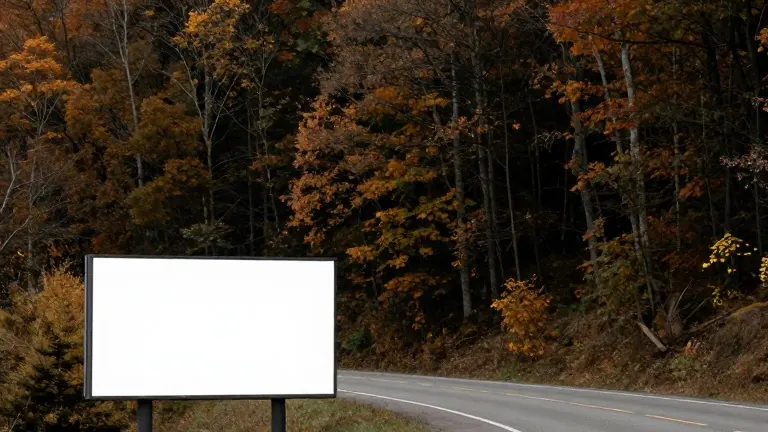
Four states in the United States have legally prohibited off-premises billboards, creating a visual divide across the country. Hawaii, Alaska, Vermont, and Maine have all enacted bans on this form of outdoor advertising.
The remaining 46 states, including Massachusetts, allow the practice. This distinction became apparent to many travelers this October during peak foliage season in northern New England. The contrast between the scenic quiet of Vermont and the cluttered highways of New Hampshire and Massachusetts drew attention to the prevalence of roadside signs.
The billboard industry is dominated by three major companies: Lamar, Clear Channel, and OUTFRONT Media. Together, these firms control approximately 250,000 billboards nationwide. Mark Falzone, president of Scenic America, a nonprofit organization based in Washington, D.C., noted that the industry has grown to become a multibillion-dollar entity. Falzone, a former state representative from Saugus, Massachusetts, said he joined Scenic America in 2017 to advocate for the removal of these signs.
Scenic America argues that billboards are a visual pollution that distracts drivers. The organization points to the evolution of static signs into digital displays, which change images frequently. Falzone stated that the trade group, the Out of Home Advertising Association of America, claims billboards do not affect drivers, but he described this as a counterintuitive position. "There’s no commonsense argument for it," Falzone said. He added that the danger has increased with the widespread use of digital screens.
Vermont passed its billboard ban in 1968, a move that inspired Maine to follow suit in 1978. John Kessler, chair of the Travel Information Council in Vermont, said that the lack of billboards is the top reason travelers cite for liking the state. "When we do surveys of travelers and ask: ‘What did you like most about Vermont?’, the most common number one is the lack of billboards," Kessler said. Hawaii and Alaska also banned billboards before achieving statehood, with Alaska voters tightening restrictions further in 1998.
Scenic America provides sample legislation modeled on the laws of these four states for other jurisdictions to consider. The proposed approach bans new billboards and makes existing ones noncompliant. Owners of existing signs are compensated through an amortization process, which allows them to keep their signs up for a set number of years. The revenue earned during this period replaces the state's need to pay direct compensation. Falzone said the industry dislikes amortization but acknowledged that it eventually leads to the removal of all signs.
Other jurisdictions have also moved to limit outdoor advertising. Oregon capped the total number of billboards in 2007, requiring existing signs to be removed for new ones to be added. San Francisco banned new billboards in 2002 and has since increased restrictions. Globally, an estimated 700 communities have banned billboards, including Sao Paulo, Brazil, in 2006, and Grenoble, France, in 2014.