Jassim al-Asadi returns to marshes after two-week captivity and torture
The 69-year-old environmentalist was held by an Iran-backed militia that accused him of spying; he refused to confess and has resumed monitoring water levels in southern Iraq.
By Nia Foster ·
Two weeks. That is how long Jassim al-Asadi was held by an Iran-backed militia in southern Iraq before he was released. The 69-year-old founder of Nature Iraq was kidnapped in February 2023 while returning to his hometown of Chibayish. He has not left the marshlands since.
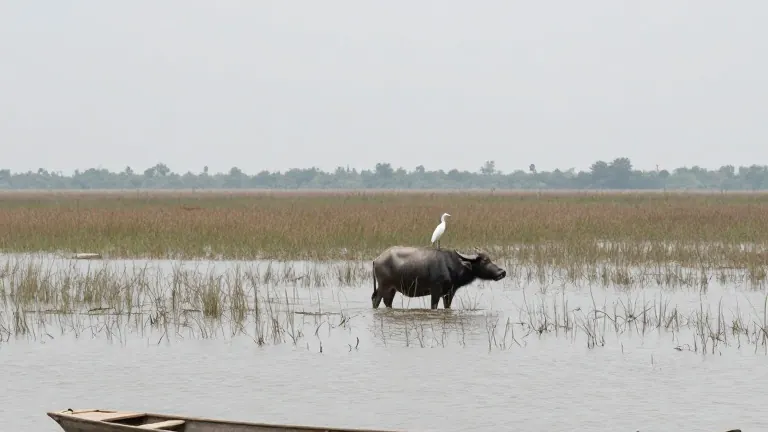
The marshes are the largest wetlands in the Middle East. Five years of drought dried out sections of the land. Brackish water stunted reeds and grass, killing water buffalo that rely on those plants for food. Herders moved their remaining animals to city outskirts or searched for freshwater. Now, following a season of rain, residents are returning to tiny floating islands where they live in a style that has changed little since Sumerian times more than 4,000 years ago.
Asadi’s work in these waters dates back to the 1990s. Saddam Hussein drained the marshes and set parts of them on fire to flush out Shiite rebels. After the 2003 U.S.-led invasion toppled Hussein, Asadi and co-founder Azzam Alwash helped residents tear down earth embankments. Water from the Tigris and Euphrates rivers flooded back in. The pair founded Nature Iraq in 2004.
The organization successfully lobbied for the site to become a UNESCO World Heritage property in 2016. The designation recognized the area’s biodiversity and its role as the site of one of the world’s oldest civilizations. Asadi worked with embassies and government ministries to secure support. He frequently guided Western journalists through the marshes, hosting them at Nature Iraq offices.
The kidnapping occurred on a road south of Baghdad. Gunmen in pickup trucks and SUVs cut off Asadi’s car. He was blindfolded, thrown to the floor of a vehicle, and driven to what he believed was farmland. His captors beat him and demanded a confession that he was an Israeli spy.
They showed him a map on a screen connecting capitals in Europe, Africa, Asia, and America to Tel Aviv. They accused him of leading a spy network and ferrying journalists into Iran. Asadi said the militia used phrases uniquely Iranian. He refused to admit guilt after being beaten.
His captors held him for two weeks. They placed a plastic bag over his head and plunged his head underwater repeatedly. They ran electric shocks through his feet, head, genitals, chest, and nose. They suspended him from a ceiling and beat his arms with metal chains. Asadi recited poetry by Iraqi poet Saadi Youssef to himself to endure the sessions.
After the two weeks, masked captors in military uniforms gave him an hour to write a will or sign a confession. He wrote that he loved Iraq and wished for the country to be independent and strong. He asked his children to follow his path. Instead of executing him, they threw him onto the floor of a vehicle and left him by a road in Baghdad near his family.
Asadi returned to the marshlands the next day. Hundreds of residents walked miles to welcome him. His Bani Asad tribe mobilized 400 armed fighters to surround the captor’s house, demanding his release. Alwash said the tribe told the captor that if Asadi died, he was dead. As part of the deal, Asadi did not pursue the case in court.
Asadi refused asylum in Europe, saying it was what his captors wanted. He asked for asylum for two children, who are now in Sweden. A third child lives in the United States. Alwash has not returned to Iraq since the kidnapping after being told by intelligence services in three countries that he was also at risk. Iran’s operating theory, according to Alwash, is that Nature Iraq is a Mossad operation because Western governments funded the environment.
Asadi is back in his boat, monitoring water levels. He talks to fishermen and buffalo herders about the impact of the recent rains. He points out white egrets perched on water buffalo and kingfishers on reeds. He sees the wildlife as if for the first time.
More Business · Consumer Watch · Report a business · Got a Story?